
A few years ago, AI in contact centers was used in a very targeted way: it recognized speech, classified requests, searched for keywords in recordings, and answered in chatbots. Each tool automated its own small area. In 2026, AI will already work with context, the knowledge base, and the customer’s systems, and has become part of everyday operations rather than a separate tech add-on.
In this article, we’ll look at where AI is already delivering practical value to an outsourced contact center, which tasks it takes on, and what that changes for the provider and the customer.
- How AI is used in a modern contact center
- What AI changes in contact center operations
- What AI gives the customer
How AI is used in a modern contact center
Artificial intelligence is used for a wide range of tasks — from assisting an agent to handling a request independently. The main solutions are:
- Voice AI agent — conducts a conversation with the customer independently;
- Text AI agent — works in chats and messengers;
- AI assistant for agents — helps to find information and perform routine actions;
- AI for quality control — analyzes conversations and written communication;
- AI for back office (internal operational processes) — helps process data and documents;
- Agentic AI — not only answers a request but can also carry out several related actions on its own. For example, find a customer in CRM, check an order, and create a case.
It is important to distinguish between these concepts: an AI assistant works together with an employee, whereas an AI agent performs part of a business process independently. In one project, they can work together and complement each other.
How an AI assistant helps an agent
An agent’s job involves more than just talking. They need to find instructions, check data in multiple systems, fill in a customer record, and log the conversation outcome. An AI assistant reduces some of this routine work. For example, it searches the knowledge base, suggests an answer, recommends the next step, finds the right procedure, and automatically prepares a brief conversation summary.
Some data can be sent to CRM without manual entry. Here, AI works on the principle of speech analytics: it recognizes the content of the conversation and extracts the required information. After that, the system automatically fills the corresponding CRM fields.
More information about neural STT and TTS in a separate article.
Agents get the data faster and spend less time filling out forms. The contact center gains a more productive team, and customers gain the ability to handle a larger volume of requests without increasing headcount.
Voice AI agents
A voice AI agent differs from a classic voice bot in that it is not constrained by a rigid script. It understands natural language, takes the conversation context into account, and can retrieve data from business systems.
For example: a customer calls to find out where their order is. The AI agent can identify them, find the order in CRM, check the status, and provide up-to-date information. If needed, it can create a case, book a service, or perform another permitted action.
When setting up an AI agent, you define in advance the situations in which it should hand the call over to a human agent. The conversation is then transferred along with its history and the data already collected, so the customer does not have to start from scratch.
Modern voice AI agents work with knowledge bases in real time and help resolve more complex issues. For a contact center, this expands the boundaries of automation: the system can now be assigned not just a standard reply, but an entire segment of the business process.
Text AI agents
A text AI agent is no less capable than a voice agent, but it addresses tasks in a different format. Its main advantage is the ability to handle multiple conversations simultaneously and work with information that is easier to share in writing. A customer can send an order number, address, link, or document, and the full conversation history is immediately preserved in the thread.
In projects with a high message volume, this format simplifies work: the text channel is simpler to scale, and when an agent joins the chat, they receive the full conversation history.
What AI changes in contact center operations
AI affects not only customer service but also internal processes: workload distribution, quality control, and team structure.
Productivity and scaling
For outsourcing, scale is especially important. A provider manages several projects simultaneously, works with varying workloads, and must respond quickly to seasonal peaks.
Voice and text AI agents can take over part of routine requests during sudden demand spikes. This creates additional capacity without increasing staff numbers.
An AI assistant helps even out service quality. It provides agents with consistent prompts, utilizes a unified knowledge base, and reminds them of the required steps. This is especially important in large projects where dozens of employees handle the same process at the same time.
How quality control changes
Traditional quality control is often based on sampling calls. Specialists listen to a sample of calls and evaluate them against established criteria.
AI makes it possible to analyze a much larger volume of interactions. The system identifies process violations, missing required information, undesirable wording, signs of conflict, and reasons for customer dissatisfaction.
Customers see not only the final KPI results but also what exactly affects them: repeated mistakes, problematic cases, procedure violations, or an increase in conflict situations.
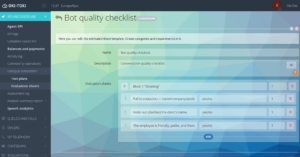
NEW! In Oki-Toki, this approach is already being tested in practice: an AI agent for quality control in closed beta checks conversations against a predefined checklist and compiles results. This helps reduce the amount of manual review and provides a more complete picture of line performance quality. To take part in testing, you can submit a request or create a ticket.
New roles and skills in the contact center
Along with AI, new types of work emerge in the contact center. These systems need to be configured, connected to data, updated, and constantly checked.
That is why new roles are emerging in teams: AI setup specialists, knowledge base managers, integration and automation experts, AI quality control specialists, and analysts.
The contact center becomes not just a hub for managing agents. The provider has to develop both the human team and the technology side of the project simultaneously.
What AI gives the customer
For customers, the value is determined not by how many AI tools the provider has but by what changes in the line’s performance.
The practical value of AI outsourcing
The most noticeable effect is speed and the ability to handle a larger volume of requests. Standard inquiries can be handled 24/7, and during peak periods, part of the workload can be passed to AI.
Other benefits are tied to operational efficiency:
- shorter handling time;
- more consistent adherence to standards;
- less repetitive manual work;
- more data regarding issues on the line;
- the ability to scale the project without proportional team growth.
At the same time, simply implementing AI does not yet guarantee savings. If the technology is used where the process is poorly prepared or requires constant employee intervention, the expected result may not appear.
It is important for the customer to understand what task AI solves and how the project metrics changed after implementation. If AI merely answers with polished phrases but does not solve the customer’s problem, it is an expensive toy, not a working tool.
Where AI is most justified
AI is most effective in clear, repeatable processes—tasks with a large number of similar requests, well-defined rules, and access to structured data.
If a process has many exceptions, the knowledge base is outdated, or a mistake can have serious consequences, implementation becomes more difficult and requires tighter control.
The provider’s job here is not to automate as much as possible. It is important to identify the areas where the technology delivers measurable results.
Artificial intelligence has changed not only individual operations, but also the entire approach to contact center development. Contact center growth now depends not only on team expansion, but also on how effectively the provider uses automation, data, knowledge bases, and integrations. Technological infrastructure is becoming just as important a resource for the contact center as the team itself.
Read more about AI for contact centers in other articles: