
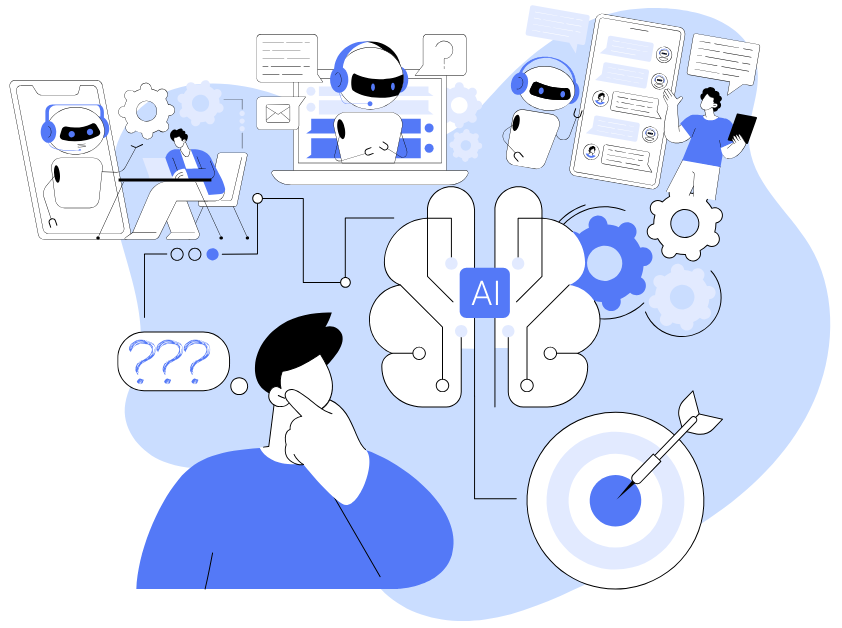
“Artificial intelligence will not replace humans. But a human using AI will replace the one who does not.”
Anastasia, Client Relationship Lead, Oki-Toki
You know what surprises me the most about conversations about AI in contact centers?
Everyone talks about technology, but no one talks about people.
During my 8 years in this industry, I’ve seen hundreds of agents who sat in “cubicles,” mechanically read scripts, and dreamed about Friday. Agents who were laid off after another “optimization”. They burned out, and the employee turnover was 30-45% per year and an endless cycle of hiring new people.
And I constantly hear this question filled with fear: “What happens when AI replaces me?”
Here’s what I say — and it’s not consolation, but a fact: Most experts are wrong when they say AI will completely replace agents.
AI won’t replace agents. AI will free agents from what killed their motivation: monotony, reading scripts, the 100th question of the day, “how to reset a password?”
The new role of agent — from performer to relationship architect
Here’s what’s actually happening: the profession of an agent is experiencing a renaissance. Agents are becoming less of a “talking FAQ” and more of a moderator of the client experience — a specialist who manages a network of AI assistants and connects in complex, emotionally or technically intense situations.
AI eliminates monotony and emphasizes Human-centric skills: EQ (Emotional quotient), Critical thinking, and creativity.
By 2025, agents will have become what they always should have been: professionals who solve problems, not repeat memorized phrases, though this is more of a trend than an accomplished fact.
The truth about what’s happening to the profession
Metrigy research shows that 55.7% of companies have reduced the number of new agents they planned to hire after implementing AI, and 36.8% of companies conducted layoffs averaging 24.1% of staff.
But, in my opinion, this is not the end of the profession but its transformation.
When I ask agents: “What would you prefer — a hundred monotonous questions a day or twenty complex ones that require thinking?” A hundred percent choose the latter, and the latter pays more.
AI automates routine, and what’s really important remains for humans — interaction, emotions, decisions, so this is not a threat to the profession, but its evolution.
How exactly does this work in practice? Let’s analyze three key future roles: Experience orchestrator, AI Supervisor, and Specialized problem solver.
Experience orchestrator — managing the client experience
When I first saw the “Agent as Coworker” model in a project in Latin America, I thought: “This is how it should always be”.
Here’s what changed: previously, the agent was alone with the client and a bunch of systems where they had to search for information. AI took this dirty work upon itself. It finds data, shows history, suggests solutions. The agent sees everything on the screen in seconds and can focus on the main thing. He hears not only words but also emotions, understands when the client needs more than a standard answer, and makes decisions that AI will never make — because they require not logic, but empathy.
Let’s consider two real scenarios that show how this works.
Case 1: Empathy and crisis resolution — anger turns into loyalty
In 2024, Delta Airlines faced a major IT glitch, which paralyzed the registration system and caused massive flight delays across the country. Clients called in fury, citing missed meetings, ruined plans, and an anger level of 9 out of 10. Analyzing this case shows how sentiment analysis helped handle the crisis.
Mechanics: Real-time sentiment analysis processed over 30,000 brand mentions daily. With sharp spikes in negativity, the system automatically passed alerts to the crisis response team. Such an approach reduced negative sentiments by 37% within 24 hours.
Let’s see what this might look like during a typical client call to an airline with AI:
- The client calls the contact center, first met by an AI bot, which offers standard compensation as per regulation;
- But simultaneously, “Sentiment Analysis” records: “Anger level: 9/10″, “Churn risk: High”;
- The system understands: a human is needed here. The call is automatically transferred to a live agent;
- The agent receives the call, ready to humanly listen and offer a level-up solution — unexpected but appreciated by the client. Instead of following the standard protocol, the agent offers:
- A ticket for the next flight in business class;
- A hotel voucher;
- A personal apology letter from the management.
Result: not just compensation, but Customer Retention.
This is the magic of the human factor. AI detected anger and assessed the risk. The human understood what to do with it and turned a disaster into a victory.
Case 2: Creativity and value-based selling — selling that doesn’t feel like selling
Let’s model another situation. A client calls an online store with a simple question: “Where’s my ski suit?”
Most agents will answer: “On its way, arriving tomorrow”. Conversation over.
And what does an agent working with AI do:
Mechanics: AI provides the agent with Contextual Data about the client in real-time: purchase history, interests, behavioral patterns, lifetime value. The agent uses this data not for “upselling” but for personalized offering that is truly beneficial for the client.
Step-by-step case:
- Client calls the online store asking about the delivery status of the ski suit;
- AI system shows the agent on the screen the following:
- “Recent purchases: mountain skis, bindings, thermal underwear”;
- “Upcoming trip (upcoming trip): Alps, in 2 weeks (according to CRM system data)”.
- The agent answers the question about delivery, and then adds:
“I see you’re preparing for some serious skiing! Our travel insurance includes coverage for extreme sports and protection for new equipment up to 5000€, which is not available with standard insurance. Considering your gear, this could be important.”
This isn’t aggressive selling but selling through added value. The client doesn’t feel pressured, they feel cared for.
When agents are allowed to think, not just read a script, the results speak for themselves: higher conversion, higher average bill, higher customer retention. And importantly, the agents work with more interest.
Specialized problem solver — “solver” of complex tasks
If the Experience Orchestrator manages the client experience together with AI and processes the entire spectrum of inquiries — from simple to complex — then the Specialized Problem Solver connects at points of highest complexity. This is an expert who handles situations where a mistake could be costly.
For example:
- In the financial sector, AI processes balance inquiries, the Experience Orchestrator deals with complaints and sales, and the Specialized Problem Solver investigates fraud or manages complex credit cases;
- In telecommunications, AI solves tariff issues, the Experience Orchestrator assists with connecting services, and the Specialized Problem Solver deals with network technical problems or negotiations with VIP customers.
According to a study of the AI industry in Latin America, Brazilian company Blip developed an AI platform for processing natural language in Portuguese and Spanish. Its bots handle over 50 million daily conversations for corporate clients such as GM, Dell, and Itaú, freeing agents to work only with complex escalations requiring knowledge of legislation, technical nuances, or negotiation skills.
According to a study by GoodCall on the transformation of agent roles, salaries in specialized positions are 20-40% higher than base levels. Hard to argue with that.
The new role of supervisor — from oversight to data science and strategic leadership
Remember the old model? The supervisor listens to 5–7% of random calls, fills out checklists, and once a month gives feedback to the agent. By that time, no one remembers what happened three weeks ago.
The supervisor no longer needs to control a random sample of calls. Now AI analyzes 100% of all calls, chats, and email inquiries for them: adherence to standards, compliance (GDPR, financial regulations), tone of conversation, quality of resolution. AI instantly finds patterns and anomalies that a human simply cannot physically see in a month of manual work.
The role of the supervisor changes radically. Supervisors stop being “error catchers” and become strategists: analyzing patterns, training teams based on data, and improving processes. AI provides transparency — shows what’s really happening. The supervisor turns this transparency into actions.
Here are two real scenarios that show how this works:
Case 1: Total quality management — 100% control instead of sampling
Studying the experience of implementing AI in the financial sector, I came across a telling case of a large American bank (I won’t disclose the name due to NDA). The problem was typical for the industry: traditional quality control analyzed only 2-5% of calls. Critical compliance violations (for example, the agent did not mention mandatory risk information when selling a financial product) could be missed.
The bank deployed an AI platform for total quality control and speech analytics — and the results impressed me. Here’s how it changed the work of supervisors.
Mechanics: QA Bot (quality control bot) analyzes all conversations by multiple criteria: AHT, Compliance (GDPR), Script Adherence, Sentiment Dynamics, and Resolution Quality. The system immediately identifies critical violations and alerts the supervisor.
Let’s see what this might look like in a supervisor’s work with AI:
- QA Bot scans 5,000 calls a week;
- The system detects a pattern: 20% of evening shift agents have low CSAT and high stress levels;
- The supervisor receives detailed analytics with call examples;
- Digs deeper — turns out, there are more calls from tired, irritated clients in the evening, and standard requests take up agents’ time;
- Solution: implements an AI bot to handle simple transactional requests in the evening (account balance, order status, password reset);
- Result: agents are freed from routine, can focus on complex emotional cases. CSAT increases by 12% in two weeks, agents’ stress is reduced.
This is data-driven management. AI showed a pattern that the supervisor would not have seen by listening to a random sample. The human understood the cause and made a strategic decision.
Case 2: AI-powered workforce management — planning based on data
Imagine another situation. The supervisor plans shifts for the next week, relying on last year’s statistics and intuition: “Mondays are usually busy; Fridays are less so.”
The problem is that reality does not match last year’s data. They launched a marketing campaign — call volume doubled, and there are not enough agents. Or the opposite — they idle because customers don’t call.
Look at what the supervisor who works with AI does:
Mechanics: Machine Learning analyzes not only the history of calls but also external factors: launching marketing campaigns, weather conditions (rainy days increase online shopping activity), brand mentions in social networks, holidays, and seasonal events. The supervisor uses this data not for guessing but for accurate load forecasting.
Step-by-step case:
- A large European retailer H&M is preparing for a summer sale launch;
- AI system analyzes factors:
- Call history during past sales;
- Planned email campaign to 500,000 subscribers;
- Weather forecast (hot weekends — more online purchases);
- Social media activity (30% increase in brand mentions).
- The system predicts: spike in inquiries +40% on Saturday from 14:00 to 18:00;
- Supervisor automatically receives a proposal for an optimal shift schedule 5 days in advance.
Result: all inquiries processed without delays, agents optimally loaded (75-85%), SLA achieved at 95%+.
This isn’t fortune-telling. It’s planning based on data. AI sees patterns that humans can’t notice, and the supervisor makes decisions that AI itself won’t make.
AI operations supervisor the one who teaches and controls AI
There’s another role that has appeared recently — and it turns everything on its head.
Before, supervisors only controlled people. Now, there are specialists who control AI.
An AI Operations Supervisor is a person who monitors how bots work. Sounds strange? In fact, it’s a critically important role. Because AI isn’t a magic “turn on and forget” button. Bots make mistakes. They give wrong answers, don’t understand slang, get stuck on non-standard requests.
Here’s what AI Operations Supervisor does:
The team analyzes where bots cope well and where they struggle. If 30% of customers asking about a return leave the chat without a solution, the system is retrained. Requests the bot fails to understand, such as “return my order money” instead of “process a return,” are identified and added to the database. The team also tracks key metrics: how many inquiries the bot resolves on its own, how many are transferred to human agents, and where customers become frustrated and ask to speak with an agent.
This is not a programmer or AI developer. It’s a person who understands both customers and technology. They make AI smarter every day because they know how people really talk, what they need, and where the system fails.
Studying materials on managing AI in contact centers, I noticed: when companies allocate a specialist to control and train bots, the results are much better. Fewer mistakes in answers, satisfied customers, more inquiries resolved without referring to humans. The logic is simple: someone is constantly monitoring the system, teaches it, and improves it.
Salary? 30-50% higher than a regular supervisor. Because such a specialist needs to understand both customer service and the technical features of AI systems, and this combination is rare.
Your future starts now
The question is not whether AI will replace agents and supervisors. The question is: who will adapt faster?
Those who develop emotional intelligence, master AI tools, and choose specialization, increase their value and salary. And those who cling to old methods risk being left behind.
Master emotional intelligence (EQ) and learn to work with AI. The good news is you don’t need to become a programmer for this. Just understand how technology enhances your abilities. Here’s where to start:
Online courses (free or inexpensive):
- Emotional Intelligence — Coursera (Arizona State University) — basics of EQ for work, ~4 weeks;
- Emotional Intelligence in Leadership — Coursera — practical strategies for teams;
- Developing Your Emotional Intelligence — LinkedIn Learning — a short course (2-3 hours);
- Customer Service in the Age of Generative AI — Coursera (University of Virginia) — how to use AI-chat bots and personalization;
- Contact Center AI: Conversational Design Fundamentals — Google Cloud — a free course on creating virtual agents;
- 10 Best Free AI Customer Service Courses — Sobot Academy — a selection of free courses;
- A classic book: “Emotional Intelligence 2.0” by Daniel Goleman.
Practice skills with Chat GPT
One of the easiest ways to level up your skills: training with Chat GPT. Always available, doesn’t get offended by mistakes.
Ask it to play the role of an unhappy client, engage in a conversation, and get feedback. When it gets easy, complicate the scenarios: the client demands the impossible or gets personal.
Request training from your employer
Is your company implementing AI? Demand training and time for practice. This isn’t a request, it’s your right as a professional.
We’ve discussed what’s happening with the agent profession and what roles are appearing. But how does this work in terms of technology? What specific AI tools are changing the game rules? And most importantly: how do leaders implement all this in their contact centers, without turning the process into chaos?
More on this in the second part. There I’ll show the technological mechanics of transformation: from specific AI scenarios to a step-by-step roadmap for implementation. With cases, metrics, and real ROI figures.