
We all have called a call center at some point, and we understand how important it is for communication with an agent to be professional and friendly. However, not all agents know how to communicate with customers at a high level. So how do you control the work of call center agents and improve service quality? In this article, we will explain the special methods that can help you solve this issue.
What Is Call Evaluation for Agents and Why Is It Needed?
Have you ever wondered how to check how well an agent in a contact center is doing their job? One way is call evaluation. It is a process of analyzing and assessing the quality of customer service, carried out by contact center specialists.
What happens during call evaluation? Specialists listen to recorded phone conversations between agents and customers and rate the agents’ performance against various criteria. They pay attention to how polite and friendly the agent was, how accurately they understood the customer’s problem, and how quickly they resolved it.
Why is this needed? First and foremost, call evaluation helps identify issues in agents’ work and improve customer service quality. Once specialists spot communication gaps with customers, they conduct additional training with agents to raise their qualifications.
In addition, call evaluation helps identify successful strategies and working methods used by agents that can be applied when training new employees. In this way, it is a very important process that allows contact centers not only to improve customer service quality, but also to grow and evolve.
So don’t be afraid to communicate with agents — they are regularly evaluated and continuously improve their skills to deliver the highest possible level of customer service.
What Oki-Toki tools help evaluate agents’ calls?
A contact center is an important communication channel between a business and its customers. In most cases, the work of agents in a contact center affects brand image and customer satisfaction. However, achieving high agent performance is not always easy. In this case, you can use some Oki-Toki tools that help control agents’ work.
Dialog Evaluation
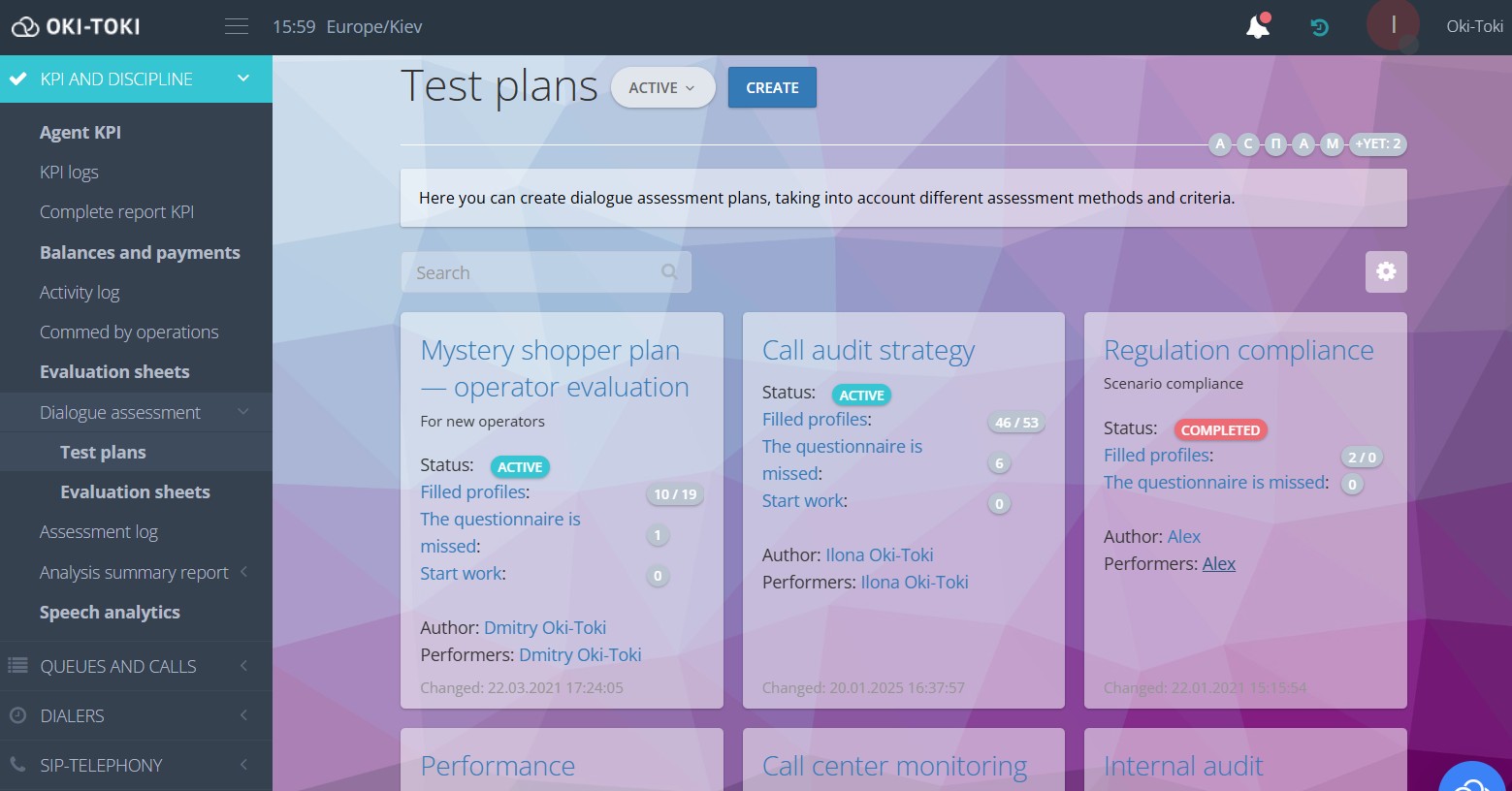
Dialog Evaluation is one of Oki-Toki’s key features for call center quality control. This feature makes it possible to rate a call based on criteria related to the quality of the dialogue between the agent and the customer.
Dialog Evaluation helps identify problem areas in agents’ communication with customers, assess their professionalism, and provide recommendations for improving service quality.
Transcript
Thanks to transcripts, you can quickly read a conversation without spending time listening to it. And karaoke mode lets you match the audio recording to the text and highlight it while listening. You can also export call recordings to a file and to Google Drive.
Speech Analytics
Speech Analytics is an important tool for quality control of agents. It automatically adds tags to transcripts, pointing to issues that a supervisor or quality assurance team should pay attention to. With this feature, you can track the agent interrupting the customer, pauses in the dialogue, and the use of profanity.
You can read more about call speech analytics and call center agent tools in a separate article.
It is important to note that Oki-Toki offers the best value on the market, making it an attractive choice for companies looking to improve service quality and streamline their processes.
What Is KPI for a Call Center Agent?
KPI (Key Performance Indicators) are key metrics of agent performance in a call center. They help determine how successfully agents handle their tasks and achieve their goals.
The main KPIs for call center agents are: call answer time, queue wait time, talk time, and the number of calls handled over a certain period. Customer satisfaction and the number of repeat contacts can also be used as KPI metrics.
Using KPI allows agents to track their performance and improve their work in order to achieve goals and raise customer service quality.
It is important to remember that KPI is not the only performance indicator for analyzing agents’ work in a call center. It is essential to consider the overall business goals and customer expectations. In addition, agents should strive to deliver high-quality service while listening to customer needs.
What Are the Main KPI for a Call Center?
-
Average Speed of Answer (Average Speed of Answer, ASA). This metric shows the average time it takes an agent to answer a customer call. ASA is an important metric because long wait times can negatively affect customer satisfaction.
-
Average Handle Time (Average Handle Time, AHT). AHT shows the average time agents spend handling a customer call, including talk time and hold time. This metric helps assess agent productivity and determine whether additional training is needed.
-
Service Level (Service Level, SL). SL defines the percentage of calls that agents should answer within a certain time frame, for example within 20 seconds. This metric helps ensure a fast response for customers.
-
Call Volume (Call Volume). Call volume shows the number of calls coming into the call center. This metric helps assess the workload on agents and determine whether additional staff should be hired.
-
Conversion Rate (Conversion Rate). Conversion rate shows the percentage of calls that lead to the desired outcome, such as a product sale or a customer issue being resolved. This metric tracks agent performance and helps determine whether changes need to be made to the customer service process.
Of course, there are many other KPI that can be used in a call center. But understanding the main metrics will help determine what should be prioritized first. That is why regular call evaluation for agents, analysis of the results, and the implementation of improvements will significantly raise the quality of customer conversations and the overall efficiency of the call center.