*This material is not advertising material. Information is obtained from the official websites of providers and based on our clients’ experience. Tariffs and connection terms should be clarified directly with the telecom operator. Oki-Toki is not a representative of the listed companies.
If you work with Oki-Toki or are just planning to, you will need telephony. The service has queue routing, dialers, scripts and reports, but without a SIP number, the system will not be able to receive and make calls.
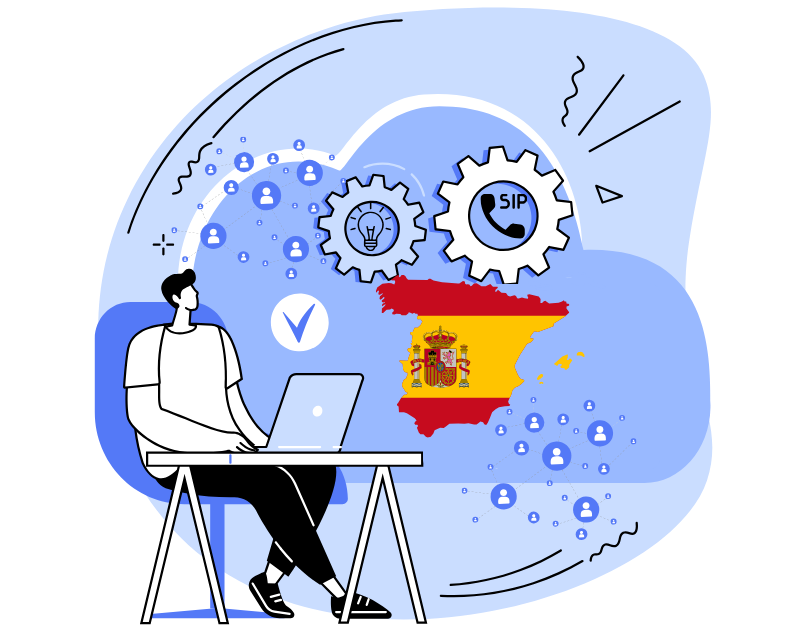
A SIP number in Spain is also a matter of trust. The client sees a number with the +34 prefix and is more likely to answer. It doesn’t matter where your agents are physically located, in Madrid, Paris or Bali.
Usually the same question arises. Which provider to choose so as not to encounter problems during peak hours? Below is a list of operators with contacts and key information. No advertising, just what’s important for work.
What’s really behind choosing a provider
It seems like it’s just about the number. In practice, this determines how the telephony will work.
A good provider works invisibly. While everything is stable, you don’t think about it. As soon as problems appear, they immediately affect the result.
It is the provider who determines whether the call will reach the client and in what quality. Whether the client will see a number in +34 format or an unknown number that doesn’t inspire confidence. Whether the line will withstand the load during peak hours or start to fail at the most important moment.
When evaluating a provider, it is important to pay attention to several things. Whether Caller ID is transmitted correctly in +34 format. How the system behaves during simultaneous calls. Whether there are restrictions on dialers during mass campaigns. How quickly new channels can be added as a team grows. And how support works in practice, especially in non-standard situations.
How it technically works
SIP number (Session Initiation Protocol) is a virtual phone number that works over the internet. You receive data from the provider and configure the connection in your PBX.
Two main connection formats:
SIP registration is login + password + server address. The most common option.
SIP trunk is authorization by IP address. Suitable for high loads and dialers. For contact centers with outbound campaigns, this is the preferred option: more stable at high CPS (calls per second), and providers are more loyal to a low percentage of successful connections.
What SIP telephony providers are available in Spain
Netelip
Netelip is a local Spanish provider. It works without long-term contracts, has virtual numbers from 58+ countries and an SMS API.
Suitable for:
- small businesses and call centers;
- projects that require telephony integration with other services via API;
Enreach España (formerly Telsome + Masvoz)
Enreach España is a European platform with offices in Spain. It specializes exclusively in VoIP, covering all provinces of Spain plus 60 countries.
Suitable for:
- corporate segment and complex routing schemes;
- projects where the provider’s technical expertise is important.
LCRcom (Grupo Aire)
LCRcom (Grupo Aire) is a Spanish company. It offers VoIP, SIP trunks, numbers, virtual PBX and mobile communications under the LCRcom brand. It works with different telephony formats within one solution.
Suitable for:
- small and medium businesses;
- projects based on 3CX or Yeastar.
Telefónica Global Solutions
Telefónica Global Solutions is a major operator with its own infrastructure and solutions for business. It offers SIP trunks and is focused on companies with high requirements for stability and communication quality.
Suitable for:
- large companies with reliability and SLA requirements;
- projects with a large volume of calls.
International providers with coverage in Spain
If you need flexible integration, API or presence in several countries simultaneously, we recommend considering international services.
Lexicall
Lexicall is an international VoIP provider with 15 years of experience working specifically with call centers. It offers per-second billing, CC-routes with Caller ID support, and NOC 24/7.
Suitable for:
- call centers with high outbound traffic;
- projects where per-second billing and Caller ID support are critical.
DIDWW
DIDWW is a licensed operator with its own numbers in 30+ countries. It offers solutions for international telephony.
Suitable for:
- integrations with high requirements for reliability and fault tolerance;
- projects that need REST API and full control over infrastructure.
DIDLogic
DIDLogic is a provider with direct connections to local operators in 12 points of presence around the world. It uses its own infrastructure for call routing.
Suitable for:
- projects where low latency is critical;
- call centers with AI agents and high requirements for connection quality.
Common mistakes when choosing a provider
Usually, problems start not at the moment of connection, but a little later.
- They look at the start, not the real cost
The connection is inexpensive and looks attractive. But then it turns out that each additional channel is paid separately, traffic is limited, and the subscription fee is above market rates. The full picture becomes clear only after the first full month of operation.
- They don’t check how the provider behaves under load
With a small number of calls, everything works stably. But when launching a campaign for 15–20 agents, failures begin. Some providers limit the speed of outbound calls or block numbers with a sharp increase in activity. It’s better to find this out in advance.
- They don’t pay attention to Caller ID
The client sees a technical number instead of your +34 and doesn’t answer. CRM doesn’t recognize the incoming call, and data is lost. This is a small detail that directly affects connection rate and analytics.
- They don’t clarify technical details before starting work
What type of connection is used. Whether a static IP is needed. How quickly the number of channels can be increased as the team grows. These parameters differ among different providers, so it’s better to clarify them in advance.
What to ask the provider before connection
At this stage, many limit themselves to basic questions and move on. As a rule, this is enough to connect. But not enough to work calmly afterwards.
Providers rarely talk about their limitations in advance. Not because they want to hide them, but because they were simply not asked.
It’s better to clarify key points immediately than to deal with them during the process.
What’s worth checking:
- What format of numbers: local (9 digits) or with country code (+34)?
- Is there a SIP trunk, or only registration by login/password?
- What CPS does the provider allow — critical for dialers.
- Is there a trial period?
- What does the caller ID look like: the number that the client sees during an outbound call?
- Are there restrictions on mass dialing?
How to connect a SIP number to Oki-Toki
Any of the listed providers can be connected to Oki-Toki. After receiving data from the provider, setup takes a few minutes, and you can start working.
In Oki-Toki, you can simultaneously use several providers. For example, one for incoming calls, a second for outbound campaigns, a third as a backup.
Do not connect several numbers at once. It’s better to start with one and check how incoming calls are handled, whether outbound calls go through stably and how the system behaves under load. This is enough to draw initial conclusions.
If you are just considering a solution, start simply. Register in Oki-Toki, connect a number and test the script for your tasks.
After that, it becomes clear whether the service is suitable and what further settings are needed.
You can learn more useful and interesting information here: