

When a contractor loses a major project, the explanation is usually found immediately. Competitors offered a lower price. The client cut the budget. The department head changed. Or the market simply slumped. Sometimes that’s exactly what happened.
But if you analyze more such stories, a curious detail emerges: major projects almost never end suddenly. Almost always there’s a chain of signals preceding it, and almost always they weren’t noticed in time.
We’ve collected situations that most often lead to contractor changes. This analysis will help clients see weak spots earlier, and contact center managers fix them before termination.
The client stops understanding what’s happening on the project
Everything is good at the start. Meetings on schedule, clear reporting, results are discussed. Then a couple of months pass, the project work enters routine mode, and calls naturally become less frequent.
A minor thing? At first glance, yes. But it’s exactly from such details that the client gradually loses the feeling of control over the project.
That’s why in recent years more and more companies are asking for direct access to data. Previously, many were satisfied with a monthly report — today businesses want to view line metrics, agent workload, call recordings, and metric dynamics themselves. And it’s not about distrust, it’s just calmer this way.
When there aren’t enough people available
Probably the most typical situation in outsourcing. Someone quit, someone is on sick leave, vacancies weren’t filled in time — for a contact center this is routine. But the client feels it much more acutely: customers wait longer, missed calls appear, SLA drops.
Although staff shortage itself isn’t a catastrophe yet; it becomes a disaster when the CC can’t quickly redistribute the load and adapt.
Contact centers are increasingly adopting load distribution tools:
- queue priorities;
- flexible routing;
- agent transfers between projects;
- real-time workload monitoring.
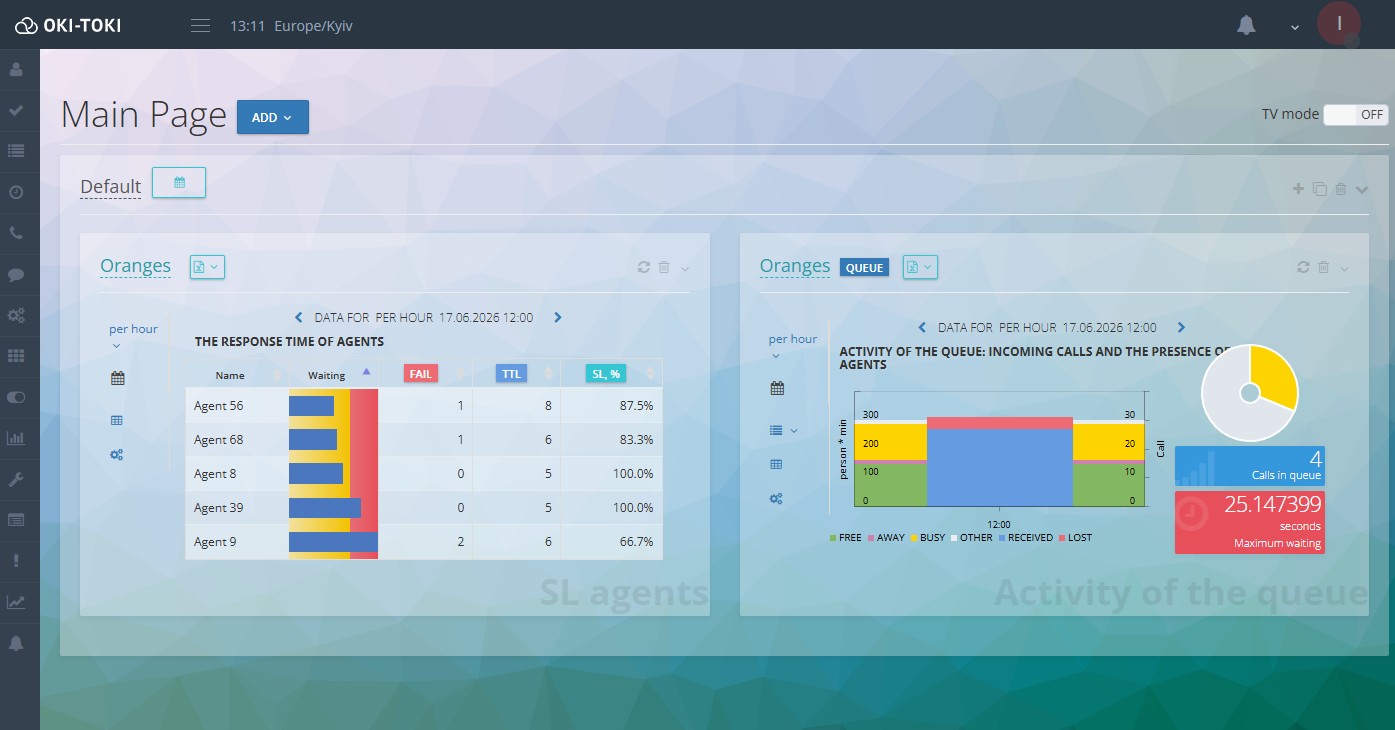
This approach smooths out load peaks and helps maintain quality even when there aren’t enough people available.
The irreplaceable employee syndrome
Almost every CC has someone who knows the project better than anyone — an account manager, team lead, supervisor. As long as they’re in place, the project runs stably. Difficulties begin when they quit.
The newcomer asks questions, digs through old correspondence, raises forgotten agreements — tries to reassemble the context. The client sees this from the outside, and it looks strange, especially if the cooperation is already several years old.
Part of the context, fortunately, doesn’t disappear with the person’s departure: call recordings, quality assessments, line statistics and performance history remain in the system, and the new employee can rely on them. But the project’s operational memory — agreements with the client, process nuances, working notes — still depends on people and regulations. So it makes sense to document it separately, rather than relying on the fact that “everyone already knows.” The less the project depends on one irreplaceable person, the smoother the team change goes — and the calmer the client feels.
Quality drops imperceptibly
Almost any project at launch receives maximum attention: best agents, management attention, tight control. Then strong employees are transferred to new tasks, newcomers go available, scripts gradually become outdated, and quality control turns into a formality.
The contractor still considers the project successful. But the client already sees that the service isn’t what it used to be. For brands where reputation depends on every conversation, this is especially painful.
And rarely is one weak agent to blame. More often quality declines on its own — simply because it stopped being regularly monitored. That’s why many CCs streamline conversation assessment, revise checklists, analyze interactions. This way you notice the problem earlier than the client does.
Silence irritates more than mistakes
Everyone makes mistakes, and clients understand this. No one expects perfect work 24/7 without a single failure. But almost no one forgives an information vacuum. When a message hangs unanswered, a task is stuck without feedback, and you learn about a problem after the fact, that’s a failure.
That’s why contact centers establish clear communication rules:
- they define how quickly they respond to client requests;
- maintain common work chats;
- set notifications for critical events;
- keep tasks in a single workspace.
The less information is lost between people and channels, the less chance that an ordinary work question will grow into a conflict.
Data manipulation and loss of trust
Any questions about numbers from the client are already a serious signal. Moreover, the reason can be anything: an error in the report, different understanding of the same KPI, a disputed situation with several requests. There’s nothing terrible about such questions. It’s bad when the client can’t independently verify the data.
That’s why access to statistics, call recordings, and other data is becoming common practice today. When both sides see the same picture of the project, disputed situations become noticeably fewer.
Why clients rarely complain directly
One of the most dangerous myths in outsourcing. The contractor thinks: if they’re dissatisfied — they’ll say so. But in reality, it’s different.
Large companies don’t arrange emotional confrontations. They just start watching the project more closely. They request additional reports, access to statistics, raise metrics for past periods. And often it’s at this moment that they’re already looking for a replacement.
To not miss this moment, you need to regularly gather feedback, meet not just for KPIs, but simply to understand how the client is doing with the project, and notice when their engagement changes. Often these signals reveal the risk earliest of all.
Not everything depends on the contractor
Over years of working with contact centers, we’ve seen the opposite more than once: the source of problems was the client themselves. New KPIs, change of responsible persons, process redesign, endless approvals. For business this is normal. But when the rules of the game change mid-project, maintaining a stable result becomes increasingly difficult for the contractor.
Flexible software helps a lot. If a CC can change the processing script on the fly, reconfigure routing, update reporting or connect a new integration without a month of refinements — adapting is much easier. And both benefit: the client gets results faster, the contractor doesn’t lose stability.
The market is also changing
There are reasons for leaving that have nothing to do with CC work quality at all. For example, transition to in-house. When volumes grow to a certain level, it’s more profitable for companies to build their own contact center and keep processes, data and economics completely in-house.
A second factor is automation. Voice robots, AI, self-service take on more and more standard requests. This is no longer a novelty, but the norm.
That’s why in 2026, agents alone are no longer enough. Clients expect from contact centers not just request processing, but also help in process optimization, routine task automation and customer service efficiency improvement.
How to understand that a project is already at risk
If you put together the signs that most often herald departure, the picture becomes recognizable. The client calls for meetings less often and gradually there are fewer new tasks. But requests for reports and statistics grow, as do questions about quality and performance control.
Signals come not only from communication. They’re also visible in the project itself: missed calls grow, repeat requests become more frequent, SLA deviations appear.
Any of these signs by itself may mean nothing. But if they appear together, the contact center should take the initiative — reach out for a conversation, propose process review, before the client starts looking for a replacement.
Where Oki-Toki can help here
Over years of work, thousands of projects have gone through Oki-Toki — from small teams of several agents to large outsourcing contact centers with dozens of clients simultaneously.
Today the platform combines project management, call management, quality control, automation, analytics, and client interaction tools in a single space. What does this approach provide:
- For contact centers this is the working foundation: inbound and outbound calls management, dialers, IVR and routing setup, chats and messengers, and if necessary — integration with CRM and other systems via API.
- For managers — the ability to see the project in real time — who’s busy with what, how metrics are performing, where quality is dropping, and what’s happening with reporting.
- For clients — to get access to statistics, call recordings, project work results and other data through separate roles and dashboards.
- For agents — to organize a full-fledged agent workplace directly in the browser without being tied to the office.
- For quality control departments — to use checklists, conversation assessment and new AI-tools* for communication analysis.
*NEW: So that quality control doesn’t hit the wall of manual sampling, Oki-Toki is testing in closed beta an AI-agent for QA: it independently checks dialogues against your checklist and provides comprehensive analytics across the entire call base, not just a few random ones. To participate in testing — leave a request on the website or create a ticket.
The more projects a contact center manages, the more important a unified management system becomes. When statistics, quality control, communications and operational processes are collected in one place, it’s easier for managers to see the overall picture, and for clients — to understand how the project works.
This is exactly the task that Oki-Toki helps solve, combining tools for agents, managers, QA and clients within a single platform.