
The agent knows the product, confidently leads the conversation, quickly handles complex requests, and meets KPIs. But the job itself stays the same for months: inbound calls, familiar scripts, typical objections, the same scope of responsibility. At some point, the employee realizes there is no professional growth within the current role. Resignation becomes a way to move to the next level, while the company loses a specialist in whose training resources were invested.
Why do experienced agents stop developing, and what growth options can you offer within the team?
Why an agent’s professional growth stalls
After a year and a half to two years, an agent usually masters the project: knows the product, understands the reasons for customer contacts, quickly navigates scripts, and handles objections, conflicts, and non-standard requests.
The problem arises when competencies grow, but responsibilities remain the same.
- No new tasks. The employee keeps taking calls using standard scripts. KPIs remain stable, quality is high, but more complex functions are not assigned to them.
- Workload grows, but not their qualifications. A strong agent gets more queues, extra shifts, more customers. The workload increases, but the skill set does not.
- Experience is only partly used. They could already be conducting training, analyzing problem calls, improving scripts, and taking part in quality control, but the job still takes place only on the frontline.
Formally, the employee is performing their duties. But they do not see what new professional knowledge they will gain in six months or a year.
How to spot the changes
An agent rarely states immediately that they no longer see a future. First, behavior changes:
- they take extra shifts less often;
- participate less in discussions;
- stop suggesting improvements;
- show no interest in new projects;
- help colleagues less often;
- work strictly by the book.
It is also useful to track the individual KPI trends for a specific employee. Key metrics include call quality, productivity, workload, the number of complex contacts, and participation in extra tasks.
For example, an agent consistently meets the plan, but for several months does not take on new functions, participates less in teamwork, and stops suggesting changes. One such sign proves nothing, but several combined are a reason to discuss career goals.
It is better to talk not only about the current workload, but also about professional interests: what the employee wants to learn, which processes interest them, and where their experience can be used.
What a contact center can do
Growth does not always require a new position. Often it is enough to gradually expand the job role and assign tasks that require accumulated experience.
The key is not to replace development with extra workload. Here is what you can do:
- Formalize mentoring. If an agent trains newcomers, coaching should be formalized as a separate function: allocate time, define responsibilities, expected results, and additional pay.
- Introduce qualification levels. For each level, you can define a set of skills, KPI, authority, and requirements for promotion.
- Delegate complex cases. An experienced employee can handle conflict requests, customer retention, script optimization, complex sales, and complaint resolution.
- Show different career paths. Growth is not limited to a supervisory role. There is quality control, analytics, training, automation, speech analytics, and configuring bots and AI.
If qualifications grow but responsibilities do not change, the employee quickly stops perceiving strong results as development.
Some routine work can be handed over to automation
Repetitive processes do not always require an agent’s involvement. Standard notifications, confirmations, mass outbound calls, reminders, and simple informational calls can be automated.
This frees up agents for tasks where their experience directly affects the outcome:
- complex sales;
- customer retention;
- handling negativity;
- conflict requests;
- non-standard requests;
- mentoring;
- quality control.
If a customer needs to confirm an order or receive a standard notification, a bot can handle the task. But a conversation with a person who wants to cancel a service or needs a non-standard solution requires experience, product knowledge, and negotiation skills.
Automation changes the way workload is distributed. The system handles repetitive operations, while the agent manages requests that require analysis, argumentation, product knowledge, and independent decision-making.
How an agent’s career has changed
In the past, the career path was short: agent, senior agent, supervisor. Automation and AI have added new specializations. And experience as a frontline agent is useful in these roles.
An agent understands customer inquiries, the causes of conflicts, weak points in scripts, common mistakes, and moments when the standard script becomes ineffective.
This knowledge can be applied in several directions:
- Quality control specialist — listens to calls, identifies mistakes, and helps improve agent performance.
- Trainer or mentor — trains newcomers, reviews calls, and helps them master the project faster.
- Complex case specialist — works with conflicts, disputed cases, and non-standard requests.
- Project analyst — tracks KPI, workload, and repeat contacts, and looks for the reasons behind performance drops.
- Speech analytics specialist — studies recordings and transcripts, identifies frequent complaints and causes of conflicts.
- Script developer for bots and AI agents — creates and tests scripts, configures dialogue logic, and routes requests to an agent.
- AI quality specialist — checks bot responses, finds errors, and identifies problematic scripts.
- Automation specialist — decides which processes can be handed over to the system and where an agent is still needed.
This type of transition does not always require a new headcount slot. At first, an employee can be given a few hours a week for a new function.
One agent assists with quality control, another trains interns, a third tests bot scripts or handles problematic calls. This way, the company sees results, and the employee explores a new specialization without a sudden career switch.
That is how employee knowledge and experience stay inside the company. The agent gets new tasks, and the business does not lose someone who already knows the product, the customers, and the workflows.
What will the agents of the future look like as AI develops? We cover that in a separate article.
Oki-Toki tools for agent training and growth
Oki-Toki is a cloud contact center with telephony, automation, analytics, and quality control tools. These features can be used not only for frontline work, but also for upskilling.
- Process automation. Dialer, voice bots, and scripts handle part of the repetitive tasks. Agents have more time for complex requests.
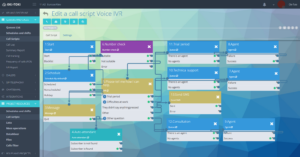
- Quality control. Call recordings, transcripts, and evaluations make it possible to review conversations, identify mistakes, train newcomers, and check service standards.
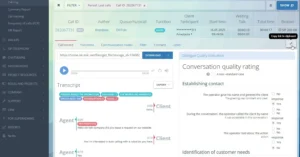
- Analytics. Reports and KPI show productivity, quality, workload, performance trends, and the types of requests the employee already handles confidently.

- Tools for new specializations. Speech analytics, voice bots, call scripts, and automation give the agent a chance to move into quality control, analytics, script configuration, or work with AI.
Oki-Toki does not determine an agent’s qualification and does not choose a career path for them. The system provides factual data: KPI, results, call ratings, contact statistics, and performance trends.
It is the manager who decides, based on that data, which skills to develop. Experience becomes more valuable when it is applied in new processes. That is why a contact center must not only retain strong employees, but also change their role over time. Then accumulated knowledge works not for call volume, but for service quality, team training, analytics, automation, and the growth of the contact center itself.