
Many outsourced call centers have the same story: at the start, all the energy goes into launching the site, finding operators, setting up processes, training the team, and onboarding the first projects. But time passes, and a new task appears. Not even a task, but a question that starts coming up regularly in meetings:
“Where do we find new clients?”
This question becomes especially urgent after a large project ends or a client leaves. Yesterday, the team was fully loaded, and today some operators are idle.
Many managers believe that the main problem in outsourcing is service quality. In practice, it is a little more complicated. Good service helps retain clients, but it does not guarantee new client acquisition.
That is why client acquisition becomes a separate area of work. And the sooner the call center manager understands this, the more stable the company’s growth becomes.
- Why most outsourcing companies look for clients the wrong way
- Where to look for your first clients
- Why use cases sell better than advertising
- The technologies clients want to see
- What can stop you from winning a tender at the start
- How to retain a client after project launch
- How to handle a shortage of clients
- How Oki-Toki helps
Why most outsourcing companies look for clients the wrong way
When it comes to selling call center services, many companies follow the same scenario. Create a website→Buy ads→Send commercial offers→Wait for requests. The problem is that the market changed a long time ago.
Today, clients receive dozens of similar offers from different contractors. Almost everyone promises a high level of service, modern technology, experienced operators, and an individual approach.
As a result, everyone starts to look the same. A client opens several websites in a row and sees almost identical texts. So the main question is no longer how to talk about yourself, but how you are different.
If an outsourcing center works with everyone and is ready to handle any task, clients will find it difficult to understand its specialization.
It is much easier to sell services when you have clear expertise.
For example:
- online stores;
- delivery;
- medical projects;
- real estate;
- financial services;
- telemarketing;
- technical support.
The clearer the specialization, the easier it is to explain to the client why they should choose you.
Where to look for your first clients
Many managers expect new clients to come through the website on their own: leave a request, fill out a form, ask for a quote. This does happen, but in outsourcing, rarely does only one channel work. Good projects usually come from different places — recommendations, contacts, events, communities, and old connections.
The first source is recommendations.
Recommendations are the most underestimated channel. Yes, it sounds simple, but in B2B it is still one of the strongest ways to get a client. If the client is comfortable working with you, sees the result, and does not waste time on constant control, they may well recommend you to colleagues or partners.
So sometimes it is more useful not to launch another advertising campaign, but to take a closer look at current clients. where communication can be improved, where reports can be delivered faster, where more transparency can be shown, and where you can simply stay in touch more often. These things do not look like “marketing”, but they often bring new clients later.
The second source is professional communities and industry events.
If a call center works not only in its local market, it is worth going where customer service managers, CX directors, support managers, and operations managers communicate. This is not always direct sales. Sometimes you first need to simply stay visible: take part in discussions, watch what tasks concern the market, meet people, and show that you understand their challenges.
There are several notable platforms for this in Europe. For example, Customer Contact Week Europe. It brings together managers of contact centers, customer service, and digital service channels. This is not a call center exhibition for call centers, but rather a platform where potential clients from retail, e-commerce, banking, logistics, and SaaS companies may be present.
For an outsourcing team, this is a good chance to understand who is looking for contractors and what services are currently interesting to the market.
Another option is CCW Berlin. This is a European conference about customer service, contact centers, and digital service channels. There you can meet companies that need external teams for support, sales, telemarketing, or request processing.
You can also use ContactCenterWorld to find contacts. It is an international resource about contact centers: news, ratings, events, and market participants. Platforms like this make it convenient to track who is active in the industry, where new projects appear, and who you can try to start a conversation with.
In Europe, there is also the European Customer Contact Alliance — an association of national contact center and customer service associations. It is not a place for quick leads, but it is a useful environment for networking, industry contacts, and understanding where the market is moving.
A separate channel is LinkedIn. For outsourcing, it can work better than advertising. Look not for business owners, but for people responsible for customer service. Outsourcing is most often needed by companies in such areas as:
- e-commerce;
- logistics and delivery;
- medical services;
- SaaS;
- financial services;
- the travel industry.
If we talk about the CIS region, it is useful to look for industry communities related to e-commerce, logistics, marketing, and customer service on LinkedIn, Telegram, and in local business associations. Clients rarely search directly for an ‘outsourced call center’. Usually, they discuss a problem: not enough operators, growing call queues, a need to call customers, or support in several languages. This is exactly when opportunities for new projects appear.
The main rule remains the same: expertise first, sales second. One useful comment in a discussion about customer service problems can lead to a project faster than dozens of cold commercial offers.
The third source is content.
Even now, many outsourcing companies underestimate the power of expert materials. When a company regularly publishes articles, case studies, and practical analyses, it gradually starts to be perceived as an expert. And clients prefer to work with those who demonstrate knowledge, not just sell services.
Why use cases sell better than advertising
For example, a website says: “We are a professional outsourced call center with an experienced team.” It sounds fine, but the client does not understand what stands behind this phrase.
It is a completely different thing when a company shows a real case study: “We helped an online store process 40,000 requests during a seasonal sale.” Or: “In three months, we increased the call connection rate in a delivery project by 22%.”
Such materials work much better than general promises. Because the client sees a specific result. That is why many successful outsourcing companies publish not only articles, but also real project stories.
The technologies clients want to see
A few years ago, having cloud telephony was considered an advantage.
Today, it is already a basic requirement. Clients want to understand how the contractor will control quality, manage the team, and ensure transparent work.
For example, in Oki-Toki, you can give the client access to reports, statistics, and project monitoring.
The client will see:
- the number of calls and calling campaign results;
- successful and unsuccessful calls;
- SL indicators and KPI achievement;
- team workload and request statistics;
- average waiting time on the line, etc.
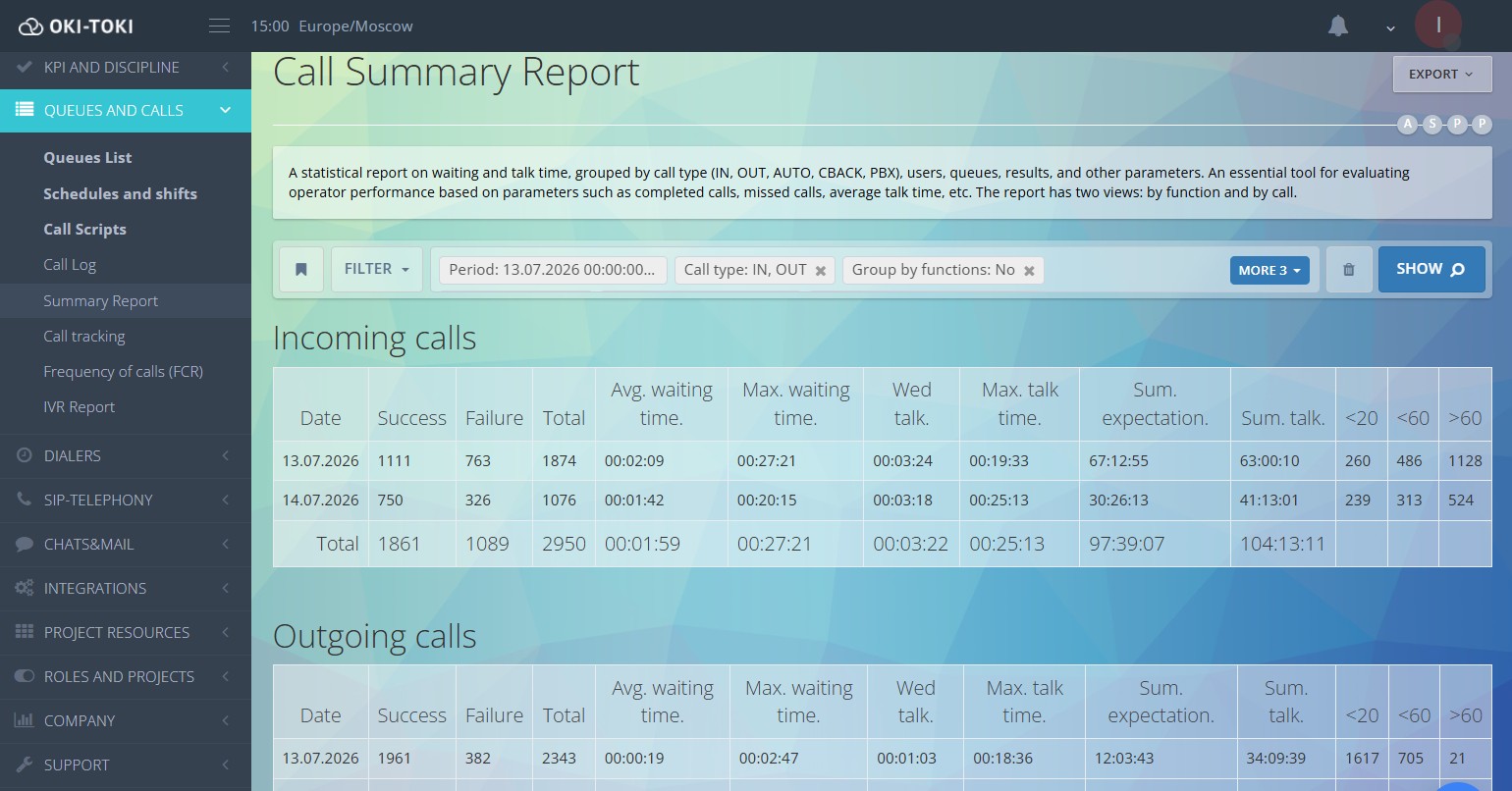
This level of transparency often influences the decision no less than the cost of services.
When the client understands that they can control the project not through endless requests to a manager, but through real data, trust appears faster.
What can stop you from winning a tender at the start
Sometimes managers are sure they lost a tender because of the price. In practice, the reason is often different. The client evaluates not only the cost, but also the risks.
If one contractor shows clear processes, statistics, reports, and quality control, while another limits itself to a nice presentation, the decision becomes obvious.
That is why, when preparing a commercial offer, it is useful to show:
- team structure;
- quality control processes;
- the reporting system;
- project indicators;
- the technologies used.
In fact, the client is not buying operators. They are buying confidence in the result.
How to retain a client after project launch
Client acquisition does not end with signing a contract. On the contrary, the most important part of the work begins after launch. It is in the first months of cooperation that the client decides whether they will continue developing the project. That is why it is important to show results regularly.
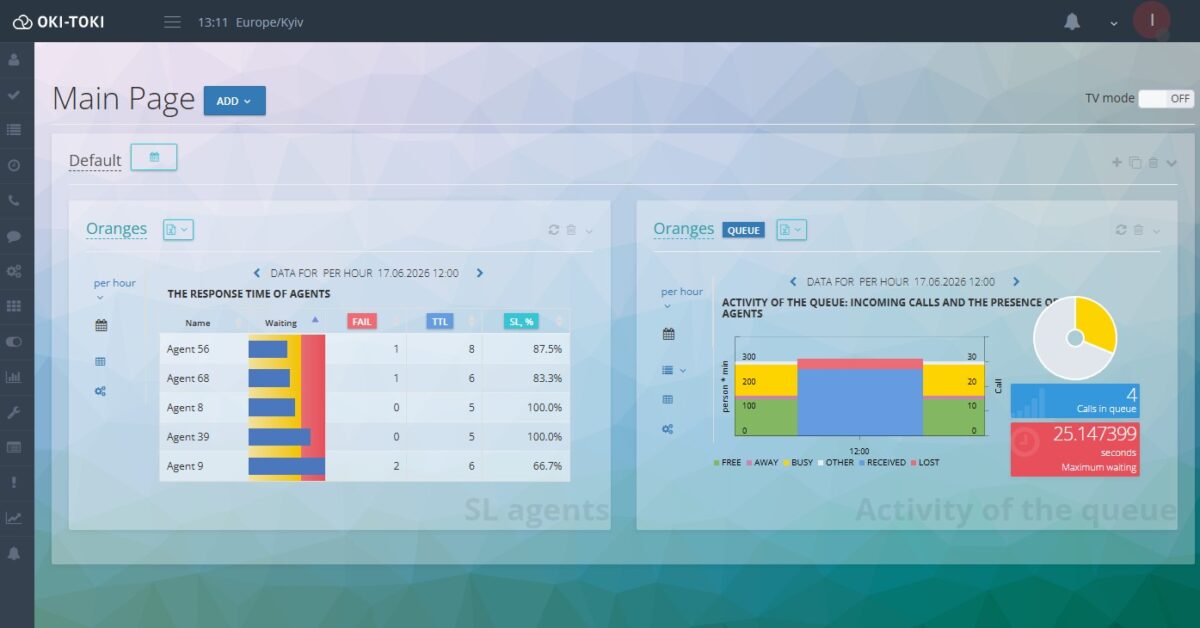
Project managers can automatically receive information about operator work, workload, service quality, and other indicators. When results are regularly visible, the client gets a sense of control over the project. And this directly affects the duration of cooperation.
In Oki-Toki, it is convenient to use reports, summaries, and dashboards for this.
How to handle a shortage of clients
When there are few requests, the first desire is to lower the price. But this does not always help the business. Low-cost projects often require the same resources as more expensive ones but bring less profit. Instead of sharply reducing prices, it is better to look at the numbers and understand:
- where the requests that most often turn into sales come from;
- which projects pay off faster and do not consume the team’s resources;
- which clients lead to long-term cooperation;
- which services are easier to explain, sell, and scale.
Sometimes it is more profitable not to try to cover the entire market, but to choose one clear niche. This makes it easier to attract suitable clients, set up advertising more accurately, and receive higher-quality requests.
How Oki-Toki helps
When an outsourced call center grows, it becomes important not only to find new clients, but also to show them a high level of work organization.
This is where tools help — they make it possible to control processes and demonstrate results to the client.
In Oki-Toki, you can launch inbound and outbound projects, process requests from chats, email, and messengers, configure operator scripts, monitor team KPIs, and track results through reports and dashboards. Transparency is especially important for the client; it is easier for them to decide on cooperation if they understand that they will be able to see real project indicators: the number of requests, processing quality, operator work, and final results.
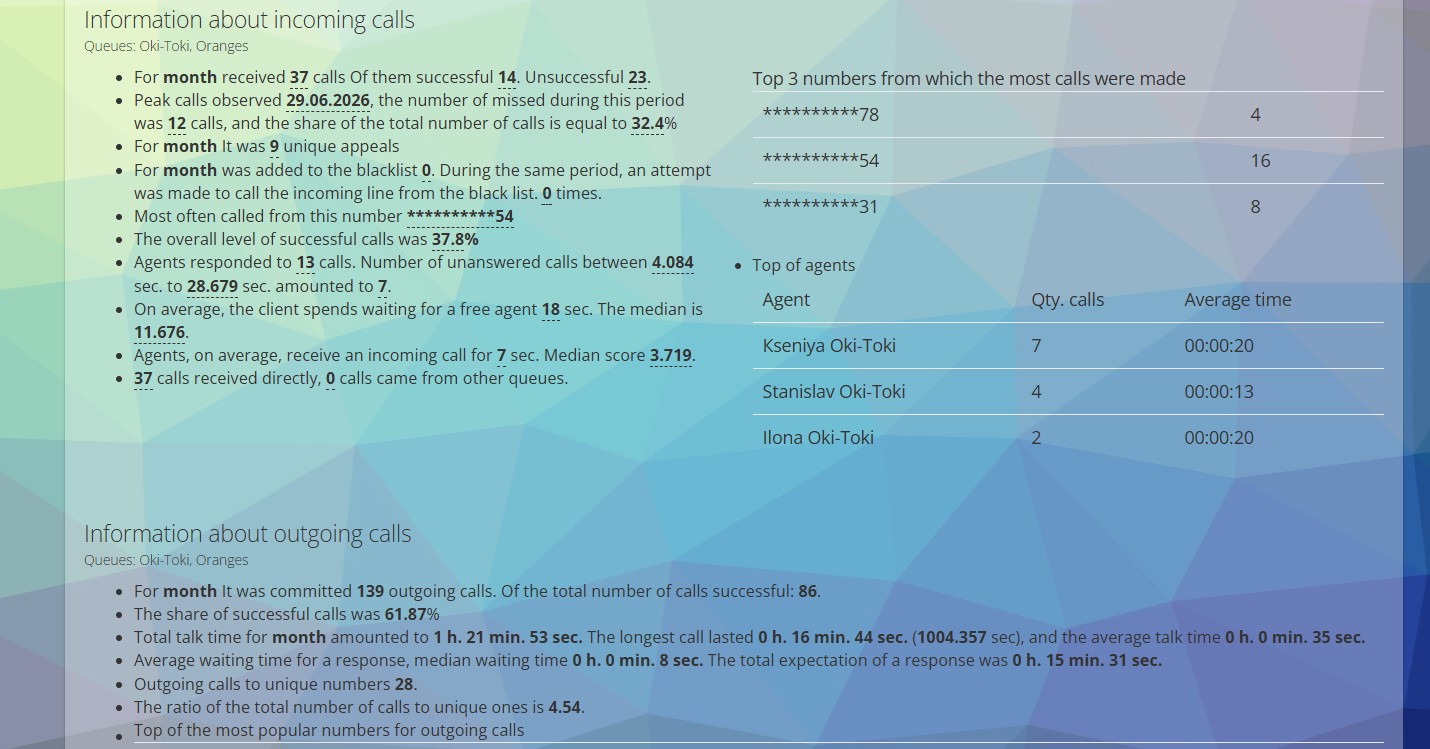
Oki-Toki also helps grow without constantly increasing the administrative workload. Analytics, automatic reports, quality control, call monitoring, and operator monitoring give managers more time for business development, client work, and finding new customers.
What is the takeaway?
Most outsourced call centers look for clients in the same way. They create a website, launch ads, and wait for requests. But the market has become much more competitive.
Today, those who show expertise, publish case studies, demonstrate process transparency, and know how to speak to the client in the language of results are the ones who win.
Finding clients is not a one-time task and not a one-month advertising campaign.
It is ongoing work that includes reputation, technologies, service quality, and the ability to show real results.
And the sooner an outsourcing company starts building this system, the less its growth depends on random projects and one-time contracts.
Other articles about outsourcing: